These solutions for testers give telecom QA teams an objective read on voice quality, from a single golden-reference comparison to a sweep across thousands of recordings. You can score with or without a reference, trace a fault to the exact moment in the audio, and automate the whole campaign, so a bad call no longer hides in the volume. Below are the tools: AQuA and PVQA for audio scoring, the PCAP Analyser and Pcaptix for captures, and QualTest for field probes.
AQuA
AQuA compares a reference recording with the file under test and returns an objective MOS, which makes it a natural fit for controlled test campaigns.

Objective MOS to P.800
Because it scores against a reference, AQuA returns an objective MOS on the ITU-T P.800 scale that you can defend in a test report.

Any length, any language
Moreover, it handles very short and very long calls in any language, so one tool covers your whole test matrix.
Across devices and networks
In addition, the analysis works for VoLTE, VoWiFi, RCS and other technologies, so the same method spans your device lab.
PVQA
PVQA scores audio quality without a reference, so you can grade real call recordings that never had a golden master.
No reference needed
Because it is single-ended, PVQA evaluates quality from the waveform alone, which suits recordings captured in the field.
Triage thousands fast
Moreover, it finds the bad records among thousands of audio files in seconds, so you start with the calls that actually need attention.

Impairment detection
In addition, it flags noisy calls, dead air, amplitude clipping, silent calls and other issues that affect what the user hears.
PCAP Analyser
The PCAP Analyser scores the voice streams recorded in a PCAP file, adding waveform analysis on top of the network metrics and standard E-model MOS.
Parse every stream
Because it reads the whole capture, it reports E-model MOS and Sevana PVQA MOS for every stream, and matches network metrics with the audio.
Pattern discovery
Moreover, it generates call-quality big data, so you can discover the impairment patterns that drag QoE down across a campaign.
Any network
In addition, it scores calls on any type of network, with a wide range of codecs supported out of the box.
Pcaptix
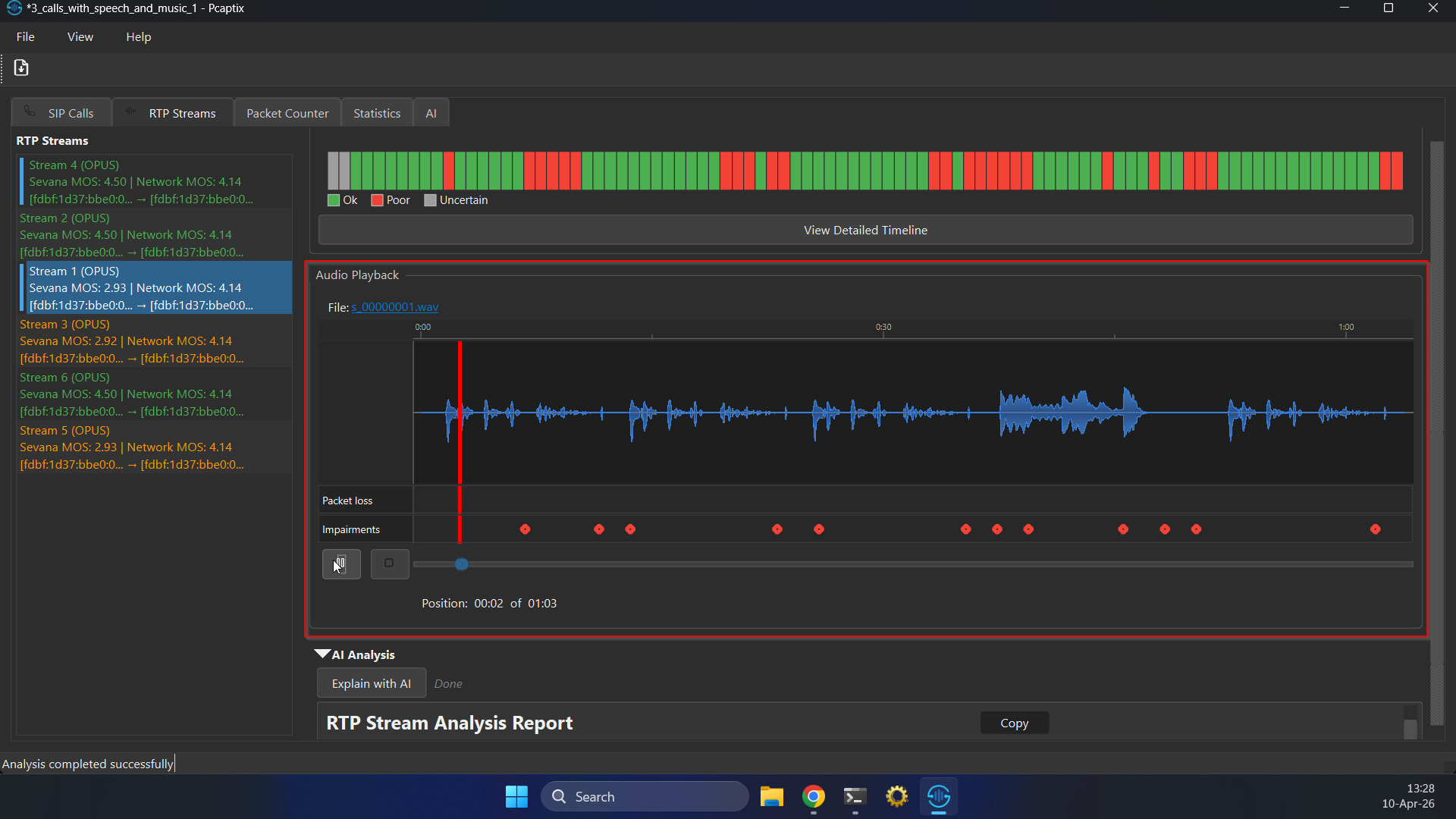
Pcaptix is the interactive app that turns a capture into a per-stream picture, so a tester can see exactly where a call went wrong.
See where audio breaks
Because the waveform carries DTMF, packet-loss and impairment markers above a quality timeline, a one-sided-audio or echo problem stands out at a glance.
Dual MOS per stream
Moreover, each stream shows a Sevana perceptual MOS beside a network-estimated MOS, so you separate a transport fault from an audio fault.
SIP call flow
In addition, the call-flow ladder and full SIP message list make a failed registration or a codec mismatch easy to confirm.
QualTest
With QualTest SIP and QualTest GSM you set up call quality probes quickly, then run scheduled tests without a person in the loop.
Active and passive in one
Because it brings the AQuA and PVQA methods together, one solution covers both reference and no-reference testing.
Automate the campaign
Moreover, automated mobile-to-mobile tests run without human interaction, which keeps overheads down in a fully automated setup.

Install and share results
In addition, you can integrate QualTest into your system and share test-result data with your engineers automatically.

For your call quality testing needs
Talk to our team about putting these solutions for testers to work in your test campaigns.


